Myra is the ancient city at Demre, on the Lycian coast west of Antalya. Most people come for one view: a theatre with a cliff of carved tombs rising behind it. The ticketed site is compact, and an hour or two covers the main sights. This page is the practical overview. For a half-day plan that adds St Nicholas Church in the town centre, read our Myra and St Nicholas Church guide.
What Myra is
The Ministry of Culture and Tourism's Turkish Museums portal places Myra in and around the centre of today's Demre, on the plain of the same name. Rock tombs, inscriptions and coins show the city existed by the 5th century BC at the latest. Lycian inscriptions call it Myrrh. The geographer Strabo counted it among the six leading cities of the Lycian League, each with three votes, and its coins show Artemis, the city's mother goddess, in the form of Cybele.
The portal says Myra grew most in the 2nd century AD, when wealthy Lycians paid for new buildings, and stayed a leading centre under Byzantium. From the 7th century, floods, earthquakes, silt from the Demre Çayı and Arab raids wore the city down. By the 12th century it was a village.
Much of Myra is still underground. In an Anadolu Agency report carried by Daily Sabah in September 2025, the head of the Myra–Andriake excavations, Professor Nevzat Çevik of Akdeniz University, said the city lies under 4 to 10 metres of river silt.
Highlights
- The theatre. It sits at the southern foot of the acropolis, and Turkish Museums says its stage building still stands to half of its second floor. Sources date it differently: the ministry calls it Roman, while GoTürkiye calls it Hellenistic. Professor Çevik gives it 11,000 seats and calls it the largest ancient theatre in Antalya; we have not seen that figure on a ministry page.
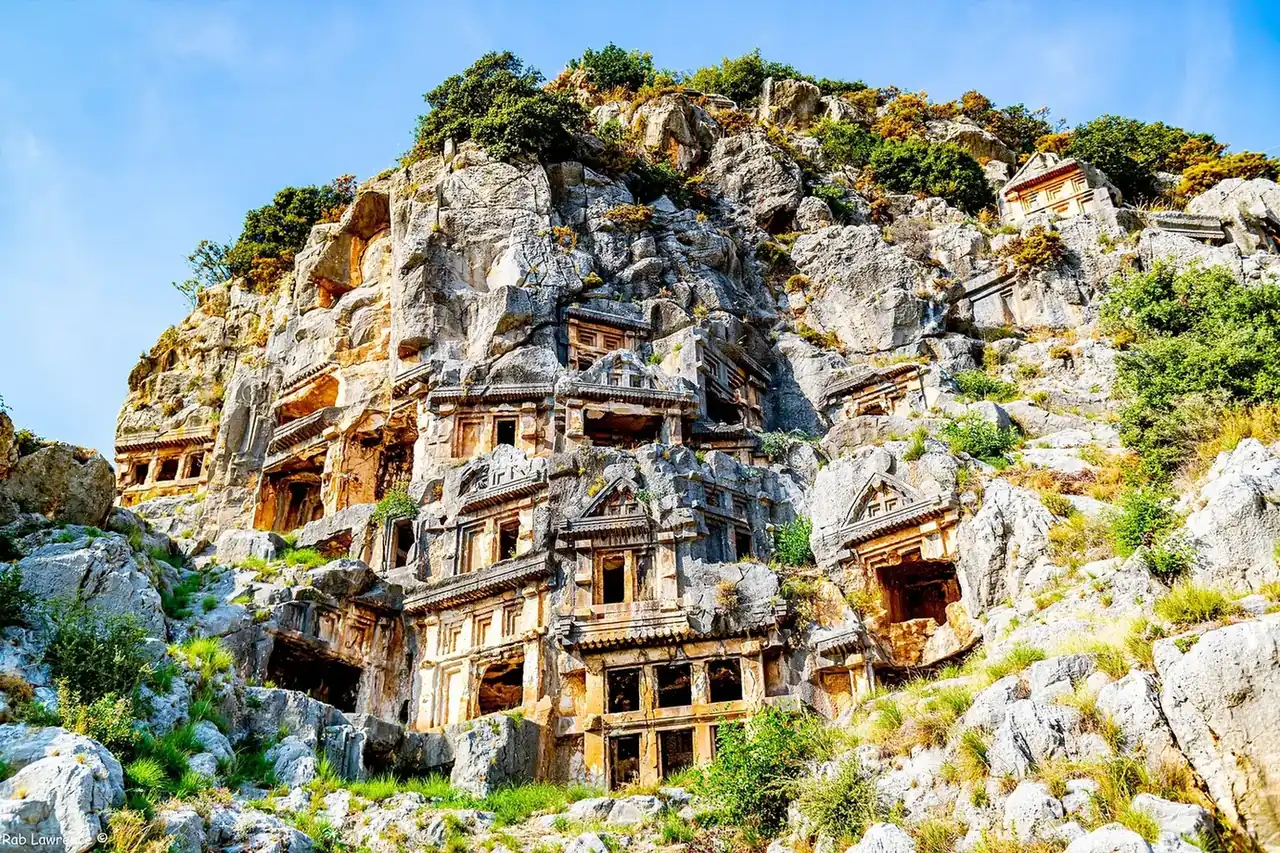
- The rock tombs. Tombs with and without reliefs are cut into the south-facing rock on both sides of the theatre, stacked or side by side. Look for the one showing the dead person with relatives. The 2025 report counts 103 Classical-period rock tombs at Myra. Our Lycian rock tombs guide explains the house-style façades and compares Myra with Limyra and Xanthos.
- The river necropolis. Wikipedia places a second group of tombs about 1.5 km up the Demre Çayı from the theatre, including the Lion Tomb, or Painted Tomb. No official page we found says how to reach it, so ask at the ticket office.
- Smaller remains. Turkish Museums points out a Roman bath built in brick beside the road, channels cut into the rock along the stream valley, and walls from the Hellenistic period, and even the 5th century BC, on the acropolis hill.
Restoration plans
According to the same 2025 report, the ministry's "Legacy for the Future" project plans to rebuild the theatre's stage building up to its first floor with original blocks found since excavations began in 2009. It gave no timetable, and Turkish Museums showed no notice of works or closures on 18 November 2026.
Tickets and opening hours
As listed on Turkish Museums on 18 November 2026:
- Winter, 1 November–31 March: 08:30–17:30 every day; the ticket office closes at 17:00.
- Summer, 1 April–31 October: 08:30–19:00; the ticket office closes at 18:30.
- Foreign visitors: €13 from age 8; under-8s free.
- Turkish citizens: 200 TL for adults; under-18s and over-65s free.
- Facilities: car park, toilets, café and shop.
The portal also sells tickets online and advertises the MuseumPass The Mediterranean at €90 for seven days, covering more than 40 museums and sites in Antalya, Mersin, Adana and Denizli. Our MuseumPass guide works out when it pays.
How to get there
GoTürkiye places the rock-cut necropolis further inland than Demre's town square and its statue of St Nicholas. Demre is on the coast road between Antalya and Kaş, so Myra fits into a long day along the coast. Our Antalya to Kaş day trip guide has the road distances, buses and timings. The Demre district guide covers the town itself.
Best time to visit
The site opens at 08:30 all year. In winter, plan to arrive by mid-afternoon, because the ticket office closes at 17:00. GoTürkiye says locals gather at the theatre to watch the sunrise or sunset, but the ticketed site keeps fixed hours, so check them before planning around either.
Turkish Museums notes that St Nicholas, the saint behind Santa Claus, became bishop of Myra. If you are visiting in December, our Christmas in Antalya guide covers what we could confirm for this season.
Tips
- Buy your ticket before 17:00 in winter. The gate stays open half an hour longer, but the office does not.
- Stay on the marked paths. Many tombs sit high on the cliff; enjoy them from below and keep off the carved fronts.
- Pair it with the church. St Nicholas Church is a separate museum in the town centre, with its own entry.
Nearby
On the way back towards Antalya, Limyra Ancient City and Arykanda Ancient City, both in Finike district, are the next Lycian sites to add. Further west, Xanthos Ancient City is best seen from a base in Kaş. For a night on the coast, browse Kaş hotels or read our Kaş district guide.