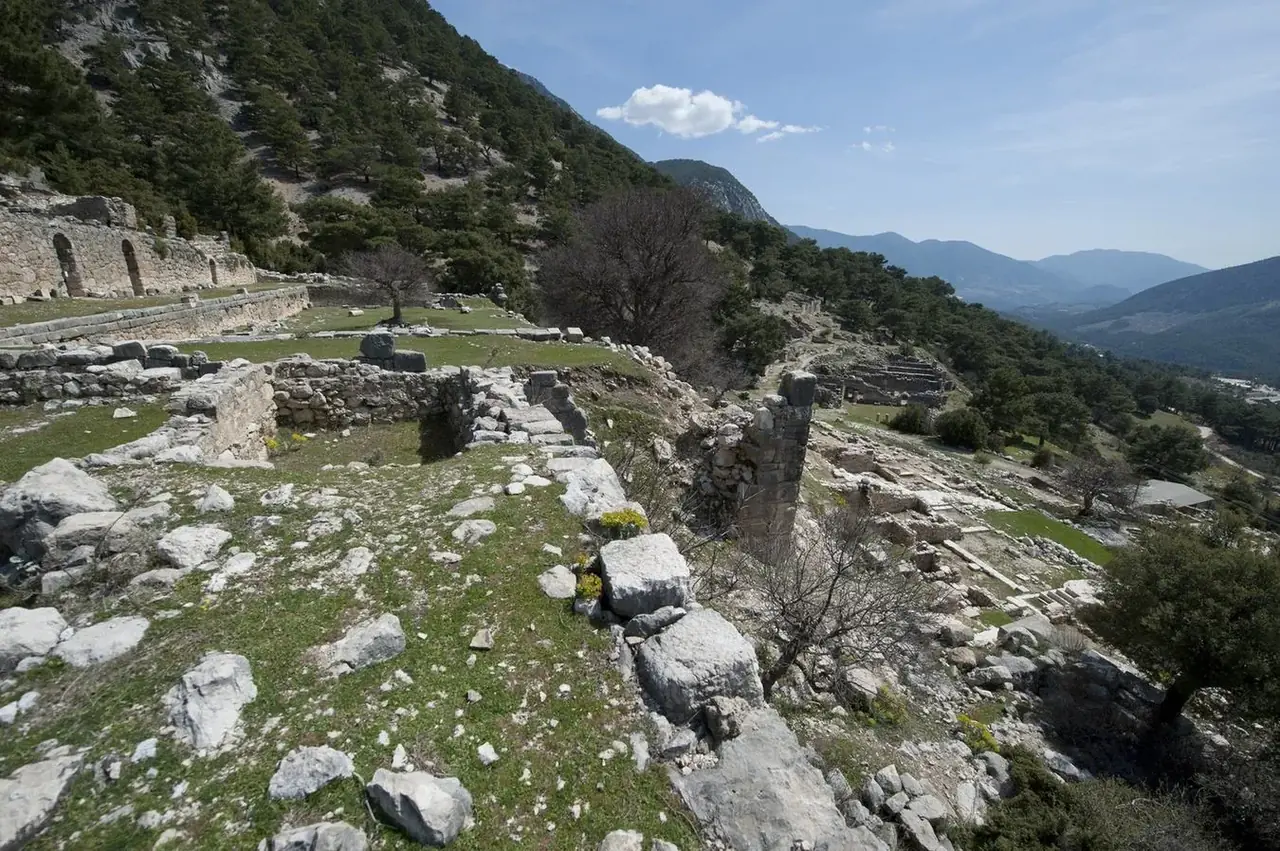
Arykanda is a Lycian city inland from the coast, and a rewarding detour for anyone driving between Antalya and Kaş. It sits on a steep slope at the foot of the Şahinkaya cliff, above the village of Arif on the road from Finike to Elmalı, and its buildings climb the hillside in terraces. The setting is the point: a mountain slope, with ruins you reach on foot, one level at a time. Entry is free.
What Arykanda is
The Ministry of Culture and Tourism calls Arykanda one of the oldest settlements in ancient Lycia. Its oldest surviving remains, the rock tombs and the Temple of Helios, date from the 4th century BC. The name is thought to come from the Luwian language and to mean "the place next to a high rock", which fits the cliff that towers over the site. Official sources differ on how far back settlement goes: the ministry says no find or text fixes the date, while a Finike booklet published by the provincial culture directorate puts the first settlers around the turn of the 3rd and 2nd millennia BC.
The city was busiest in the Hellenistic and Roman periods, when it grew rich on the timber trade, and it peaked in the 2nd and 3rd centuries AD. Instead of fortification walls, it relied on its terrace walls for defence. The ministry links its early-4th-century basilica to the legalisation of Christianity in 313, calling it one of the earliest buildings of the new religion. Earthquakes and Arab raids eventually emptied the city.
The British traveller Charles Fellows identified the site in 1838. According to the excavation team, systematic digs began in 1971 and have been led by a Hacettepe University team since 2011.
Highlights
- The great bath and gymnasium. On the lower terrace stands the bath–gymnasium complex. The ministry notes that its large bath still stands two storeys high.
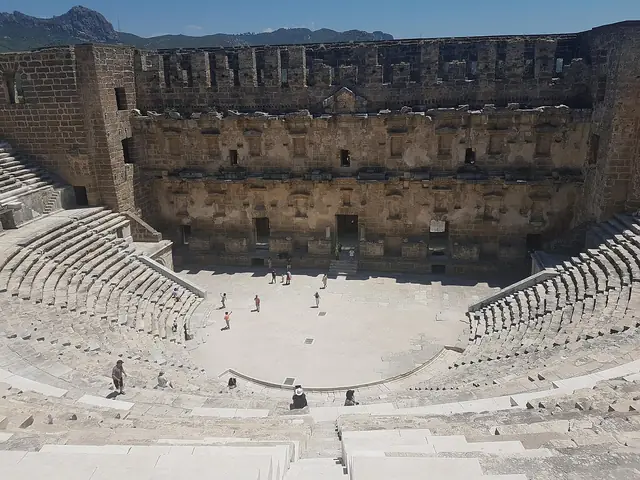
- The theatre. Small but well preserved, set into the hillside.
- The odeon. A small concert hall from the reign of Hadrian, with a porticoed agora beside it.
- The stadium. The track narrows into a trapezoid at one end, with seating on one side only.
- The agora, bouleuterion and houses. Shops lined the agora; the council house and villas with mosaic floors complete the civic quarter.
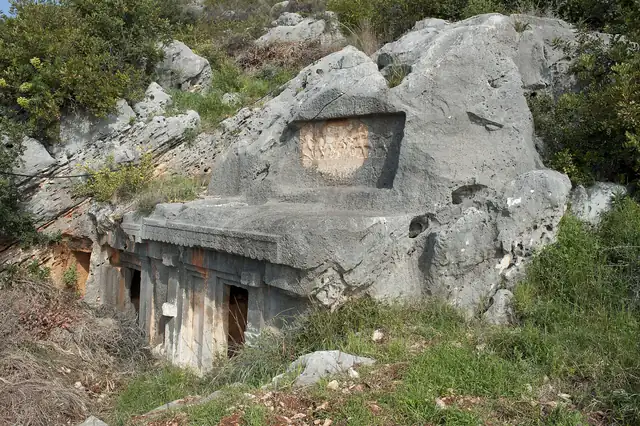
- The necropolis. The ministry says the tombs, including monumental tombs and vaulted grave chambers, cover more ground than the city's public and private buildings.
- The acropolis temples. Temples of Trajan and Helios stood at the top of the town.
- The churches. A basilica on Nal Tepe and a church in the eastern necropolis.
- The water channels. Arches cut into the rock at the springs of the Aykırı stream, which the ministry calls one of the most interesting remains on the site.
Official pages disagree on which terrace holds the theatre and odeon, but stairways link the stadium, theatre and odeon, so plan to climb.
How to get there
Arykanda is about 33 km north of Finike on the Finike–Elmalı highway, northeast of Arif village, according to the provincial culture directorate's Finike booklet. A car is the practical way to visit. If you are coming from Antalya, combine it with Demre: our guide to Myra and St Nicholas Church covers Demre, west of Finike on the coast, and the Finike district page shows the area.
No official page we found describes parking, path surfaces or step-free access. Expect uneven ground, steps between terraces and little shade.
Opening hours and tickets
The ministry's entry directive lists Arykanda as free, and the ministry's MuseumPass The Mediterranean list includes it, so you gain nothing by using a pass here. See our MuseumPass guide for the sites where it does pay.
Hours vary between official pages:
- The muze.gov.tr detail page says 08:00–19:00 every day, with the box office closing at 18:30.
- The ministry's site leaflet gives 08:00–19:00 from 1 April to 1 October and 08:00–18:00 from 1 October to 1 April.
- The ministry's Turkish Museums portal gives 08:00–17:00 in winter, with the box office closing at 16:30.
We found no closure notice when we checked on 11 November 2026. In winter, plan to arrive by early afternoon and leave before 17:00 to be safe, and check the official page before you set off.
Best time to visit
Spring and autumn suit a hillside site with climbs between terraces. In summer, come early. In winter, check the mountain weather first; our guide to Antalya in winter has more on the season.
Tips
- Wear proper shoes. This is a site of stairs and slopes, not flat paving.
- Bring water and snacks; the official pages list no café on site.
- Give it two hours if you want to reach the upper terraces.
What's nearby
- Limyra, about 4 km northeast of Finike, was a Lycian city that the ministry says Pericles used as his capital. The ministry's leaflet for Arykanda recommends it as a second stop.
- Myra and Demre: rock-cut tombs, the theatre and St Nicholas Church. See our Myra guide.
- Xanthos, further west, is another Lycian capital with a UNESCO listing: see Xanthos Ancient City.
- For another mountain city, Termessos is near Antalya itself, and our Antalya to Kaş day trip covers the coast road.