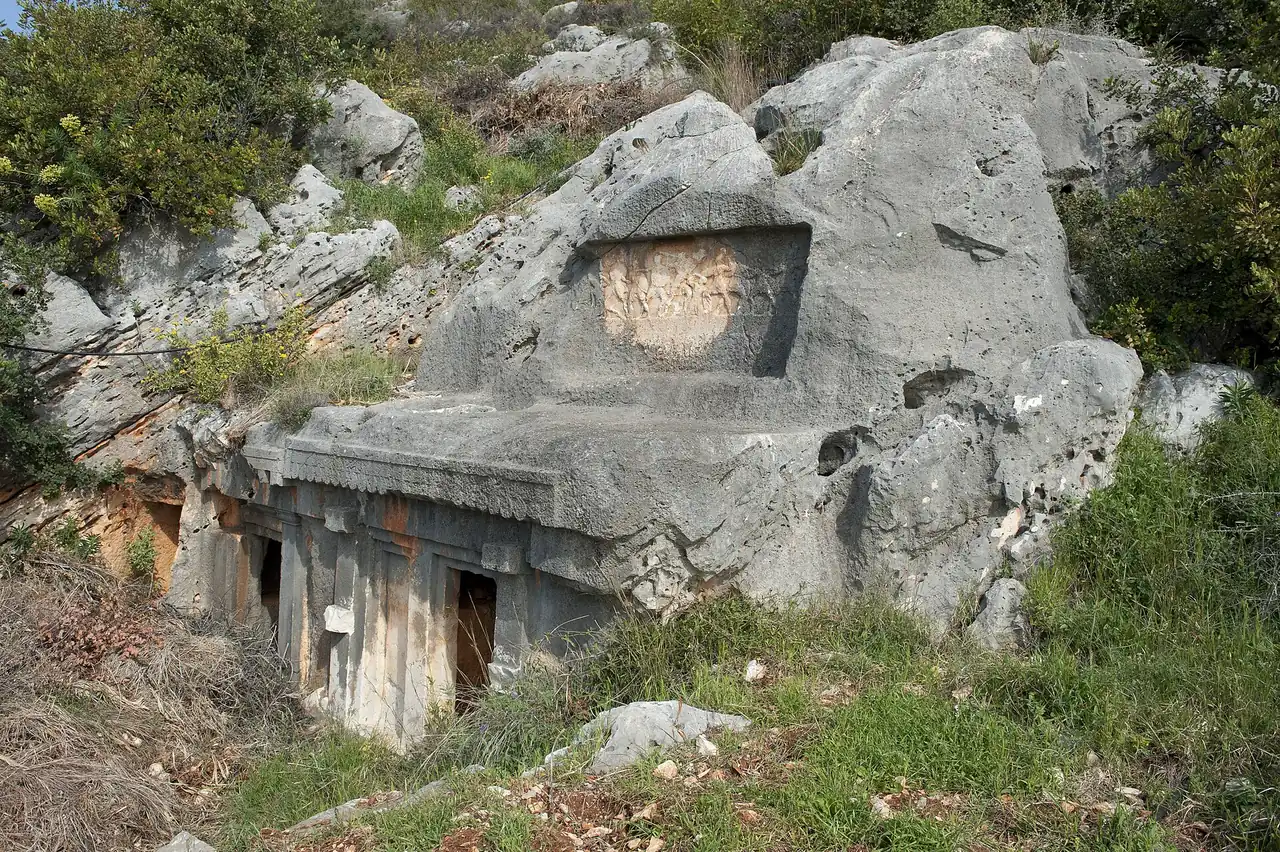
Lycian rock tombs are the signature sight of the coast west of Antalya. The Lycians cut tombs straight into cliffs, set stone coffins on pillars and carved inscriptions in a language that is still only partly understood. When Türkiye's Ministry of Culture and Tourism put the Lycian cities on UNESCO's Tentative List in 2009, it singled out the rock-cut monumental tombs as "very distinctive in Anatolia". This guide explains the main tomb types, then takes you to the three best places to see them: Myra in Demre, Limyra near Finike and Xanthos in Kaş district. Hours and prices come from the ministry's two websites, muze.gov.tr and Turkish Museums, as we found them on 17 November 2026.
Lycian rock tombs near Antalya: the short version
- Myra (Demre): the famous cliff of house-like tombs on both sides of the theatre. €13.
- Limyra (Finike): more than 400 rock-cut tombs, many with Lycian inscriptions. €3.
- Xanthos (Kaş district): pillar tombs, a 4th-century BC sarcophagus and the Harpy Monument. €3.
- Winter hours: all three close at 17:00 or 17:30, and ticket desks shut 30 minutes earlier.
- Prices are for foreign visitors aged 8 and over, as listed on Turkish Museums.
- Plan: two of the three fit in one long winter day. All three need two days, ideally with a night in Kaş.
What Lycian tombs are
The Lycian cities stood on and around the Teke Peninsula, west of Antalya. UNESCO's Tentative List entry says their league had 23 cities, and that the Lycian language and alphabet are known partly from inscriptions found in them. Many of those inscriptions are on tombs. You will meet four kinds.
House-type rock tombs
These are the façades you see on postcards. Turkish Museums calls the Myra tombs the best examples of Lycian wooden house architecture adapted to rock tombs. UNESCO describes the same idea at Xanthos as funerary monuments "imitating woodwork". In practice, that means stone carved to look like a timber-framed house.
Pillar tombs and pillar-mounted sarcophagi
UNESCO calls the rock-cut tombs, pillar tombs and pillar-mounted sarcophagi of Xanthos unique examples of ancient funerary architecture. As the names suggest, these raise the tomb or the coffin on a stone pillar. Xanthos is the place to see them.
Lycian sarcophagi
Free-standing stone coffins appear across the region, from Xanthos to the harbour of Kaş. The Antalya culture directorate describes Lycian-type sarcophagi around the Kaş harbour and inside its old walls. On the best known, the King's Tomb, lion heads are carved at the corners of the lid.
Monumental tombs
Some burials were built as monuments rather than cut into rock. The ministry's Limyra page describes King Perikle's monumental tomb in the style of the Nereid Monument at Xanthos. UNESCO adds that the Nereid Monument in turn influenced the Mausoleum of Halicarnassus.
Myra rock tombs in Demre
Myra is the classic place to see Lycian rock tombs. Turkish Museums says the city is "especially famous" for its Lycian-era rock tombs. The ruins you visit sit around the theatre at the southern foot of the acropolis.
What you see
- Tombs on both sides of the theatre. Turkish Museums describes tombs with and without reliefs, stacked on top of each other or side by side.
- House-type façades. The page calls them the best-adapted examples of wooden house architecture in rock.
- A family relief. One of the most interesting tombs shows the dead person with relatives. Look for it among the carved fronts.
Our Myra and St Nicholas Church guide covers the theatre, the church and a half-day plan, so we won't repeat them here.
Hours and tickets
- Winter (1 November–31 March): 08:30–17:30, ticket office closes 17:00 (Turkish Museums).
- Summer (1 April–31 October): 08:30–19:00, ticket office 18:30.
- Price: €13 for foreign visitors aged 8 and over; foreign children under 8 free. Turkish citizens pay 200 TL.
- Facilities: car park, toilets, café and shop.
The muze.gov.tr page for Myra would not open for us today, so we could not compare the two portals. Turkish Museums gives no distance from Antalya; see our Demre district page for the town.
Tip: many tombs sit high on the cliff. Bring binoculars or a phone with a good zoom to pick out the reliefs from the paths.
Limyra near Finike
Limyra is the place to see Lycian tombs in numbers. The ministry's English page puts it 9 km east of Finike and calls it one of the Lycian cities with the most rock tombs.
What you see
- More than 400 rock-cut tombs. Both portals give that figure. Turkish Museums says most are known from their Lycian epitaphs, and muze.gov.tr says the inscriptions name the owners.
- The Heroon of Perikle. The king's monumental tomb stands in the lower castle. muze.gov.tr dates it to the 4th century BC and says the Antalya Museum displays important parts of it; check our Antalya Museum page for the museum's status. Turkish Museums dates the tomb to the 4th century AD instead.
- The cenotaph of Gaius Caesar. An empty memorial tomb, known for its marble reliefs. muze.gov.tr says it was built in AD 4; Turkish Museums says the 4th century AD.
Hours and tickets
The two ministry portals disagree on the opening time:
- muze.gov.tr: 08:30–17:00 every day, ticket office closes 16:30.
- Turkish Museums: winter (1 November–30 April) 08:00–17:00 every day, ticket office 16:30.
- Price: €3 for foreign visitors aged 8 and over (Turkish Museums). muze.gov.tr shows no fee.
- Facilities: Turkish Museums lists toilets only, so bring water and snacks.
The address differs too: muze.gov.tr says Yuvalılar köyü, Turunçova; Turkish Museums says Arif Köyü, Finike. Our Limyra page explains where to aim for, and the Finike district page shows the area.
Tip: arrive at 08:30, when both portals agree the gate is open. The slopes are rocky, so wear proper shoes.
Xanthos in Kaş district
Xanthos is the old capital of Lycia and, for tomb lovers, the most varied site of the three. It shares its UNESCO World Heritage listing with Letoon. Turkish Museums places it in Kınık, in Kaş district, and no official page we opened gives a distance from Antalya or Kaş.
What you see
- Pillar tombs and pillar-mounted sarcophagi. UNESCO calls these, with the rock-cut tombs, unique examples of ancient funerary architecture.
- The Harpy Monument, west of the theatre (Turkish Museums).
- A Lycian sarcophagus from the 4th century BC.
- An inscribed mausoleum with Lycian and Greek text on two faces, raised for a ruler named Kheri.
- What's missing. UNESCO notes that pieces of the Harpy Monument, the Tomb of Payava and the Nereid Monument were taken to England in the 19th century.
Hours and tickets
- Turkish Museums: winter (1 November–31 March) 08:30–17:30, ticket office closes 17:00. Summer (1 April–31 October) 08:30–19:00, office 18:30.
- Ministry leaflet: 08:30–17:30 every day from 1 October to 1 April, and 08:30–19:00 from 1 April to 1 October. It gives no ticket-office time.
- Price: €3 for foreign adults; foreign children under 8 free. Turkish citizens pay 200 TL.
- Facilities: car park, toilets, café and shop.
The muze.gov.tr detail page for Xanthos showed only the portal's index when we tried it, so we could not compare it.
Tip: the leaflet says to check the website for current information. With several famous reliefs now in England, give your time to the inscriptions and the pillar tombs in their setting.
More Lycian tombs along the coast
You will pass more tombs than these three. Here is where else to look, with links to our fuller pages.
- Kaş town. The Antalya culture directorate describes the King's Tomb on Uzun Çarşı: a single-block sarcophagus from the 4th century BC with an eight-line Lycian inscription that is still undeciphered, and lion heads on the corners of its lid. It also mentions a rock-cut tomb chamber northeast of the theatre with 24 carved female figures, and rock tombs on the slope behind town.
- Patara. UNESCO's Tentative List names it as the capital of the Lycian League. Our Patara guide covers the ruins and the beach.
- Arykanda. Our Arykanda page covers this second site near Finike, including why its published hours disagree.
- Phaselis and Olympos. Both are on UNESCO's list of Lycian cities and on your way out of Antalya: see Phaselis and Olympos and the Chimaera flames.
- Simena (Kaleköy). Another league city on the Tentative List; our Antalya to Kaş guide explains the boat trip from Üçağız.
A Lycian tomb route: Antalya, Finike, Demre, Kaş
Driving west from Antalya, you reach Limyra first, then Myra, then Kaş, with Xanthos beyond. Our Antalya to Kaş day trip guide has the road distances, the bus and a full timetable, so here is just the tomb version.
Day 1: Limyra and Myra. Leave Antalya early and drive to Finike for Limyra at opening time. Spend an hour or two among the tombs, then continue west to Demre. Myra's ticket office stays open until 17:00 in winter, so it suits the afternoon. Add St Nicholas Church if there is time, then sleep in Kaş; browse Kaş hotels.
Evening in Kaş. Walk up Uzun Çarşı to the King's Tomb. It stands on the street, so it's an easy evening stop.
Day 2: Xanthos. Drive west to Kınık for Xanthos in the morning. Pair it with Patara, then head back east or on towards Fethiye.
If you have only one winter day, choose Limyra and Myra. As our Xanthos page explains, Xanthos works better from a base in Kaş than as a day trip from Antalya.
Tickets and the MuseumPass
At today's prices the three main sites cost €19 per adult: €13 for Myra and €3 each for Limyra and Xanthos. Turkish Museums lists the MuseumPass The Mediterranean at €90 for seven days, covering more than 40 sites in Antalya, Mersin, Adana and Denizli, but not night-museum visits. For tombs alone, single tickets win easily. The pass only pays if you add the big sites east of Antalya; our MuseumPass guide does the maths.
Tips for tomb sites in winter
- Watch the ticket offices. They close at 16:30 (Limyra) or 17:00 (Myra and Xanthos), not at the gate's closing time.
- Check both portals. Hours shift by season and the two ministry sites don't always agree.
- Wear grippy shoes. The tomb slopes are rocky and slippery after rain.
- Look, don't climb. Stay on the paths and admire the tombs from below.
- Pack a rain layer. Our Antalya in winter guide explains what the season brings.
FAQ
What are Lycian rock tombs?
They are tombs cut into cliffs by the Lycians of southwest Türkiye. Many are carved to look like timber houses, and many carry inscriptions in the Lycian language. UNESCO also highlights pillar tombs and pillar-mounted sarcophagi at Xanthos.
Where can I see Lycian rock tombs near Antalya?
The best sites are Myra in Demre, Limyra near Finike and Xanthos in Kaş district. Limyra and Myra fit in one long day from Antalya. Xanthos works better from Kaş.
How much does it cost to see the tombs?
On 17 November 2026, Turkish Museums listed Myra at €13 and Limyra and Xanthos at €3 each for foreign visitors aged 8 and over. Under-8s go free at Myra and Xanthos. Check before you go.
Are the tomb sites open in winter?
Yes. Turkish Museums lists Myra and Xanthos at 08:30–17:30 and Limyra at 08:00–17:00, with ticket desks closing 30 minutes earlier. muze.gov.tr gives Limyra an 08:30 start.