A Letoon and Xanthos day trip lets you see both halves of one UNESCO World Heritage Site in a single outing from Kalkan or Kaş. Xanthos ran ancient Lycia. Letoon, a few kilometres away, was its holy ground: three temples in a row beside a spring that still floods the ruins. The two sites were listed together in 1988. Letoon lies just over the provincial line in Muğla, so many Antalya itineraries skip it. That's a mistake: it costs €3 and sits a short drive from Xanthos. We checked the official pages on 24 November 2026. Where they disagree, we give both figures.
Letoon and Xanthos at a glance
| Letoon | Xanthos | Patara | |
|---|---|---|---|
| Where | Kumluova, Seydikemer (Muğla) | Kınık, Kaş (Antalya) | Gelemiş, Kaş (Antalya) |
| Fee, foreign visitors 8+ | €3 | €3 | €15 |
| Winter hours | 08:30–17:30, desk 17:30 | 08:30–17:30, desk 17:00 | 08:30–17:30, desk 17:00 |
| Summer hours | 08:30–19:30, desk 19:30 | 08:30–19:00, desk 18:30 | 08:30–19:00, desk 18:30 |
| Which MuseumPass | The Aegean | The Mediterranean | The Mediterranean |
The hours come from each site's page on Turkish Museums, the ministry's portal. The fees match the ministry's DÖSİMM fee table.
What Letoon is
The ministry's heritage office calls Letoon the religious centre of Lycia. Turkish Museums dates the sanctuary to the 7th century BC. It began with the cult of an Anatolian goddess and a nymph. In the Hellenistic period Leto, Apollo's mother in Greek myth, took their place, and the site became the sanctuary of the Lycian League. UNESCO describes it as the league's federal sanctuary, where religious and political decisions were made public.
The myth has a local twist. A Turkish Museums blog post argues that Patara's ancient date palms and lake fit the story of Apollo's birth better than Delos does, and it points to Letoon nearby as support.
The Muğla culture directorate dates the World Heritage listing to 9 December 1988. The ministry lists Xanthos-Letoon as property no. 484, inscribed under criteria (ii) and (iii).
What you'll see at Letoon
The three temples
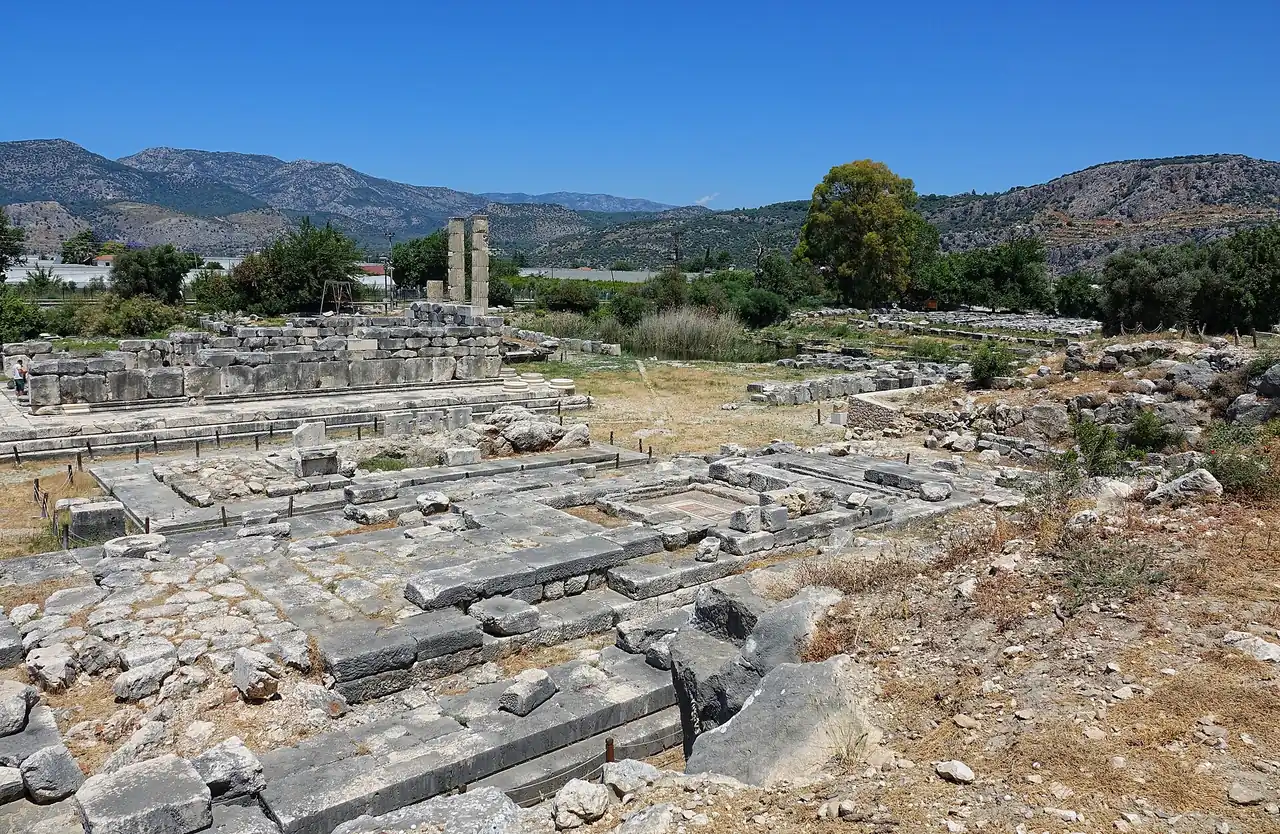
The temples stand side by side. Leto's, on the west, is the largest at 30.25 by 15.75 metres. Turkish Museums calls it Ionic and the best preserved. Apollo's, on the east, is Doric, 27.90 by 15.07 metres, and dates from the second half of the 2nd century BC; the heritage office notes it has survived less well. Artemis's small temple sits between them. The official pages give its size differently: 8.20 by 8.70 metres on Turkish Museums, 18.20 by 8.70 metres on the heritage office's page.
The trilingual inscription
Letoon's most famous find is an inscription in Lycian, Greek and Aramaic. UNESCO dates it to 337 BC and says it was found near the temple of Apollo. The Turkish-language Turkish Museums page says it came to light in 1973. Turkish Museums adds that it concerns the cult of a god from Kaunos and sets out offerings and penalties for anyone who breaks the rules. UNESCO notes that the longest and most important texts in the Lycian language were found at Xanthos and Letoon.
Don't expect to see it at the site. The Muğla culture directorate says the inscription is on display in the Fethiye Museum, but that museum is closed. Turkish Museums says it shut on 4 March 2023 for reinforcement works; the heritage office says it stays closed until earthquake-risk analysis is finished.
The flooded nymphaeum
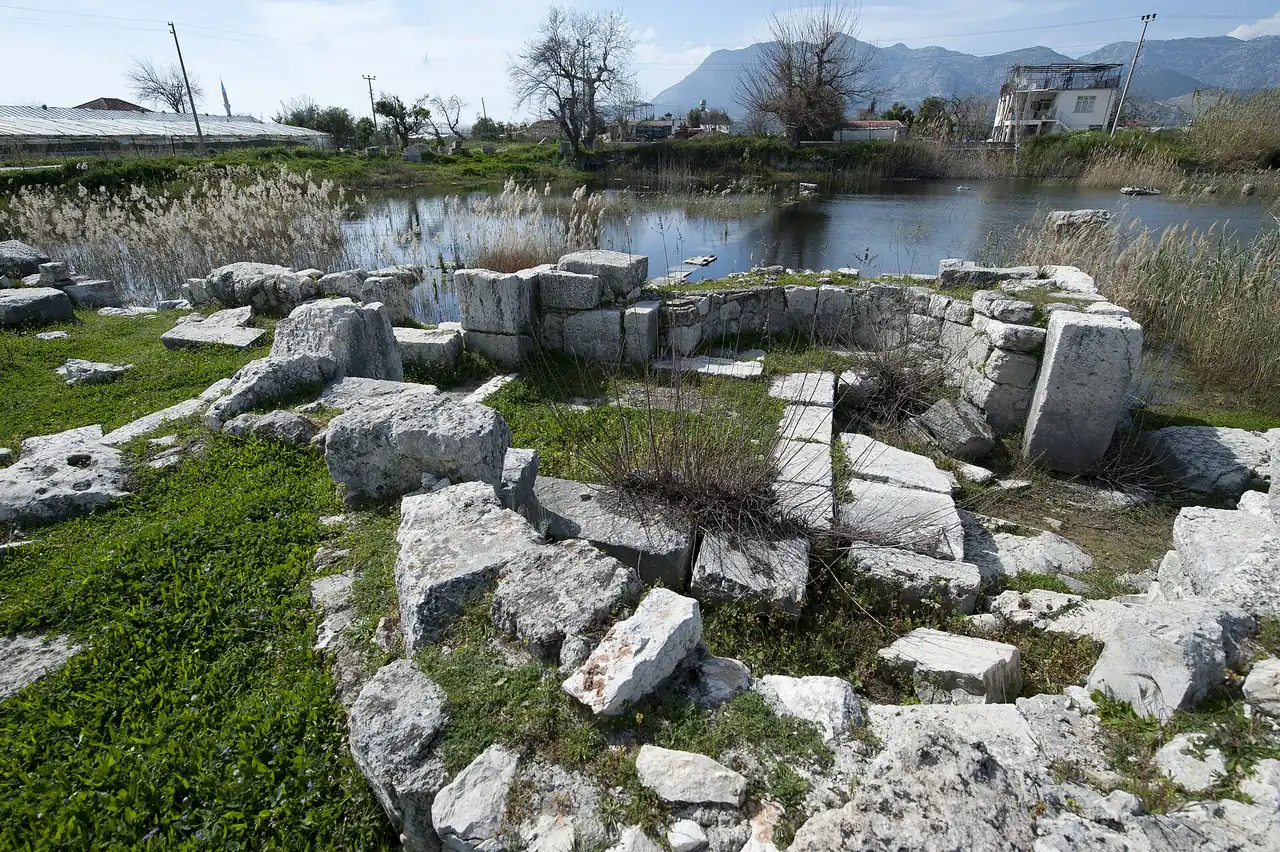
South and west of Leto's temple is a large nymphaeum, a monumental fountain house built over a sacred spring. Turkish Museums dates it to the 3rd century AD, replacing a Hellenistic building; UNESCO places it in Hadrian's time. Most of it is under water today, and part lies beneath a 6th-century church. A 2022 Turkish Museums blog post adds that the temple floors are under water too, because the water level has risen since antiquity. Expect standing water and soft ground.
The theatre and the church
At the north end of the site is a Hellenistic theatre, large and well preserved, according to Turkish Museums. South of the temples is a basilica that was abandoned in the 7th century AD. No ruins survive from the 8th century; the ministry thinks the site was deserted during the Arab raids.
A footnote: the geographer Strabo put Letoon 60 stadia from Xanthos, which the ministry's page says is wrong.
Letoon opening hours and tickets, winter and summer
- Winter: 08:30 to 17:30 every day, with the ticket desk open until 17:30, according to Turkish Museums.
- Summer: 08:30 to 19:30, desk until 19:30.
- The catch: on both the English and Turkish pages, the summer and winter rows are dated 1 April to 1 October. The page doesn't say when winter hours start, so plan around the shorter set outside high summer.
- Summer 2026 extension: the ministry's list of longer hours from 1 May to 1 October 2026 gave Letoon and Xanthos a 20:00 closing time, later than the 19:30 on Turkish Museums. Patara closed at 21:00.
- muze.gov.tr: the ministry's ticketing site did not show its Letoon page when we checked.
- Fees: €3 for foreign visitors aged 8 and over; under-8s go free. Turkish adults pay 200 TL; Turkish citizens under 18 or 65 and over go free, and the Müzekart is valid.
- Facilities: Turkish Museums lists toilets and a car park, and no café.
- Contact: the Fethiye Museum Directorate runs the site: +90 252 614 11 50.
Which MuseumPass covers Letoon?
Not the one you might expect. Letoon is on the list for the MuseumPass The Aegean (€95, seven days, covering İzmir, Aydın, Muğla and Denizli). Xanthos and Patara are on The Mediterranean (€90, seven days, covering Antalya, Mersin, Adana and Denizli). Neither regional pass covers all three. MuseumPass Türkiye costs €165 for 15 days and covers more than 350 ministry museums and sites. For this day alone, single tickets come to €21. Our MuseumPass guide explains when a pass pays off.
How to get to Letoon from Kalkan, Kaş and Patara
Turkish Museums gives Letoon's address as Kumluova, Seydikemer. The Fethiye Museum Directorate places it near Kumluova village, at kilometre 65 of the Fethiye–Kaş road. The heritage office puts it about 4 km from Xanthos, and GoTürkiye, the official tourism portal, says the drive between them takes 15 to 20 minutes.
The official distances we found:
- Kaş to Kalkan: 25 km (the ministry's Kaş page)
- Kaş to Patara: 41 km on the ministry's Kaş page, about 42 km on its Patara page
- Kaş to Xanthos: 45 km (the ministry's Kaş page)
- Xanthos to Letoon: about 4 km (heritage office)
- Fethiye to Xanthos: about 46 km (heritage office)
- Antalya to Kaş: 187 km (Highways Directorate, KGM)
No official page gives a distance from Kalkan to Letoon. Kalkan is 25 km west of Kaş on the way, so it is the closer base.
Kaş Municipality says it has finished the 110-metre Patara Bridge. The bridge links Kaş with Seydikemer, connecting neighbourhoods such as Kınık, Kumluova and Kalkan and the ancient cities of Patara, Xanthos and Letoon. The page gives no opening date, so check your map for the current route.
No car? The Muğla culture directorate says visitors come to Letoon every day from Kaş, Fethiye, Kalkan and Patara, and that the site lies on the Lycian Way; our Lycian Way guide covers the trail. We found no official bus timetable, so a hire car or a local tour is the simplest option. From Antalya it is too far for one day. Read our Antalya to Kaş day trip or fold it into the three-day Lycian coast road trip.
A day plan: Letoon, Xanthos and Patara
Morning: Letoon
Be at the gate for 08:30. An hour covers the temples, the nymphaeum and the theatre at an easy pace.
Late morning: Xanthos
Xanthos is in Kınık, in Kaş district, so you cross back into Antalya province. The heritage office calls it Lycia's largest administrative centre. It stayed independent until Persian rule in 545 BC and burned about a century later. Rebuilt, it became capital of the Lycian League in the 2nd century BC. UNESCO says its Nereid Monument directly influenced the Mausoleum at Halicarnassus. Turkish Museums gives winter hours of 08:30 to 17:30 from 1 November to 31 March (desk 17:00) and summer hours of 08:30 to 19:00 (desk 18:30). Entry is €3. It lists a café as well as toilets, a shop and parking. Our Xanthos page covers the tombs; the Lycian rock tombs guide puts them in context.
Afternoon: Patara
Turkish Museums places Patara at Gelemiş, also in Kaş district. Entry is €15. Winter hours are 08:30 to 17:30 (desk 17:00), though the winter row starts on 1 October and overlaps the summer row, which runs to 31 October (08:30 to 19:00, desk 18:30). Finish on the beach; our Patara beach guide has the rules for the sand. In winter, check sunset times in our daylight hours guide.
Optional extras: Pınara, Tlos and Saklıkent
These are all in Seydikemer and each deserves its own half-day. Pick one if you have a second day.
- Pınara: free. Turkish Museums places it about 40 km from Fethiye, 5 km west of the Fethiye–Kaş road, with the last 2 km on a stabilised road from Minare village. Look for hundreds of rock tombs on the upper acropolis, plus a theatre, agora, odeon and bath. Turkish Museums gives winter hours of 08:30 to 17:30; muze.gov.tr shows 08:30 to 18:00. Both put the last entry at 17:30.
- Tlos: €3. Turkish Museums says it sits at the foot of the Akdağlar mountains in the Xanthos valley, near kilometre 25 of the Fethiye–Antalya highway. The Muğla directorate puts it about 40 km from Fethiye and highlights a rock tomb with a Pegasus relief, a theatre and a stadium. Hours are 08:30 to 17:30 in winter, but its date rows are misprinted like Letoon's.
- Saklıkent: the Muğla directorate describes a canyon about 18 km long, with walls 200 to 600 metres high that narrow to about 2 metres in places, and a wooden walkway to the Karaçay spring. No official page we could open gave hours or a fee.
Tips for a Letoon and Xanthos day trip
- Start early. At Xanthos and Patara the winter ticket desks close at 17:00.
- Wear shoes that can get wet. The water has risen over the old floors.
- Bring water and snacks. Turkish Museums lists no café at Letoon.
- Check the official page the night before. Letoon's season dates are misprinted.
Where to stay
Kalkan is the closest base: see our Kalkan hotels, including True Blue Boutique Hotel and Lures Hotel. Kaş has more choice; browse Kaş hotels and our Kaş district guide. On the drive west from Kaş, stop at Kaputaş Beach.
FAQ
Is Letoon in Antalya or Muğla?
Muğla. Turkish Museums places it in Kumluova, Seydikemer. Xanthos and Patara are in Kaş district, Antalya.
Is Letoon open in winter?
Yes. Turkish Museums lists 08:30 to 17:30 every day with no closure notice, though its season dates are misprinted. Check before you go.
Is Letoon on the MuseumPass The Mediterranean?
No. Letoon is on the MuseumPass The Aegean list. Xanthos and Patara are on The Mediterranean. At €3, a single ticket is the easy option.
How far is Letoon from Xanthos?
About 4 km, according to the ministry's heritage office. GoTürkiye says the drive takes 15 to 20 minutes.