This Kaleiçi walking route links the old town's best sights in a single walk: start at Hadrian's Gate, follow the ancient main street to Hıdırlık Tower on the cliffs, then cross the old town to the Clock Tower and the Fluted Minaret before you drop down to the old harbour. It works as a first morning in Antalya, and it needs no ticket except for the museums. Every fact below comes from the Antalya Metropolitan Municipality, the Ministry of Culture and Tourism or the museums' own pages, checked on 11 November 2026.
The municipality's own Kaleiçi page suggests three themed routes on its Kaleiçi Culture and Tourism Map: a long tour, a Roman–Byzantine tour and an Ottoman–Seljuk tour. Our route borrows from all three. For background on the district, read our guide to Kaleiçi old town and the longer what to see in Kaleiçi.
The Kaleiçi walking route at a glance
- Hadrian's Gate (Üç Kapılar)
- Hesapçı Sokak, the ancient main street
- Suna and İnan Kıraç Kaleiçi Museum
- Kesik Minare (Şehzade Korkut Mosque)
- Hıdırlık Tower, with an optional loop through Karaalioğlu Park
- The Clock Tower and the site of Kalekapısı
- The Yivli Minare (Fluted Minaret) complex
- The old harbour, with the Ethnography Museum near Mermerli
Time: there is no official walking time. Allow half a day if you go inside both museums. Cost: the streets, the gate, the towers and the harbour are free to see. The Kaleiçi Museum charges 80 TL for adults. Closed days: the Kaleiçi Museum is closed on Mondays.
Kaleiçi in a few lines
Kaleiçi means "inside the castle". The municipality says the city was named Attaleia by King Attalos II in the 2nd century BC and was taken by the Seljuks in 1207. The ministry's culture directorate describes the walls as the shared work of Hellenistic, Roman, Byzantine, Seljuk and Ottoman builders, and counts about 3,000 tile-roofed houses inside them, many now hotels, guesthouses and bars. The old town is under protection, and the ministry's restoration project here won the FIJET Golden Apple tourism award in 1984. Most of the city walls were pulled down in the mid-1930s, the municipality notes, which is why the gates and towers now stand on their own.
Stop 1: Hadrian's Gate
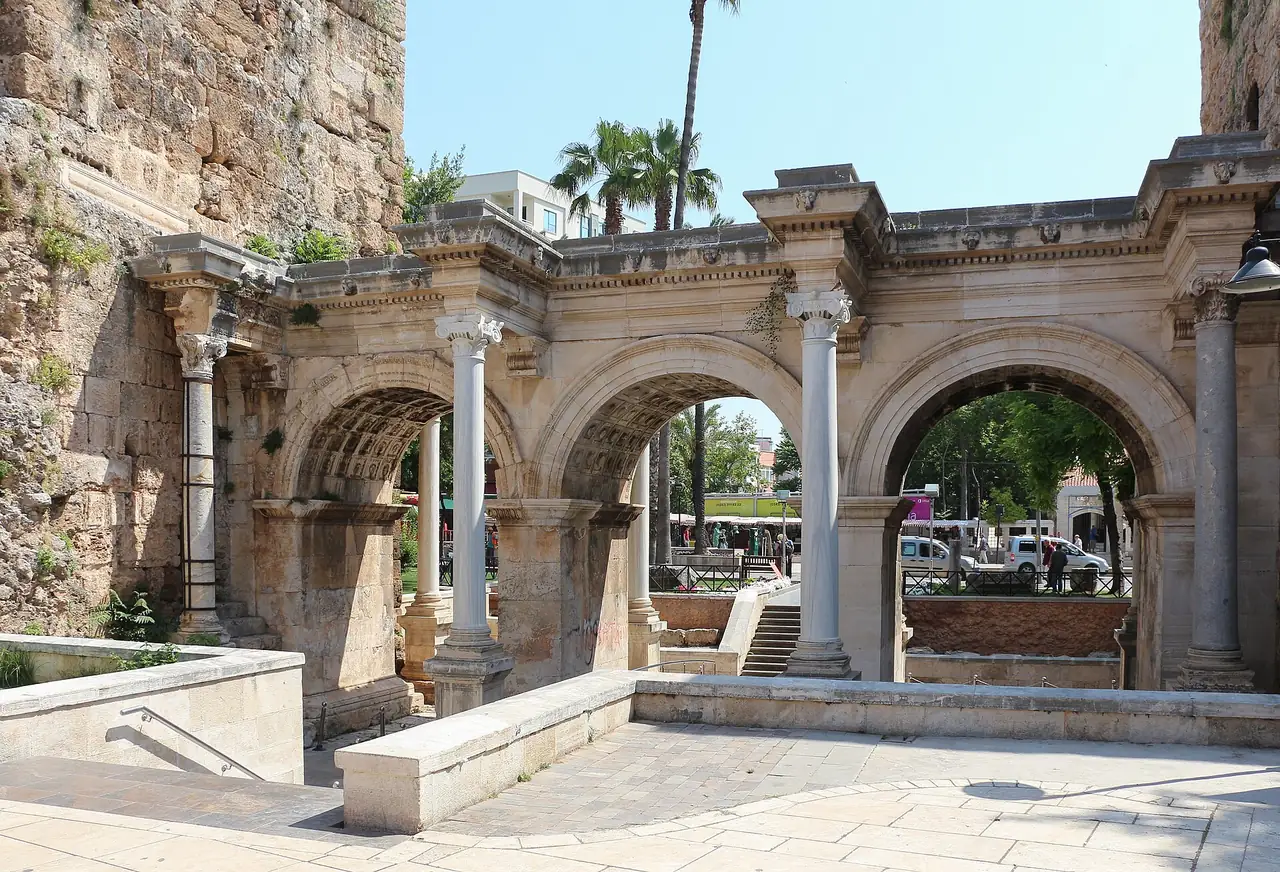
Start at the triple-arched gate on the eastern edge of the old town. The municipality dates it to around AD 130, when Emperor Hadrian visited the city, and says it stood on the main road towards Perge, Aspendos and Side. It was built for show rather than defence. In the Byzantine period it was closed off, with walls built in front of and behind it. Today it is restored and you can walk through it. Our page on Hadrian's Gate has more.
Stop 2: Hesapçı Sokak, the ancient main street
Walk through the gate and look for Hesapçı Sokak. The municipality says this was ancient Attaleia's main street, and that it ran from Hadrian's Gate all the way to Hıdırlık Tower. That makes it the natural spine of this route. The lanes on either side hold many of the old houses that the ministry counts inside the walls.
Stop 3: Suna and İnan Kıraç Kaleiçi Museum
A short detour leads to the Kaleiçi Museum, run by Koç University's AKMED research centre at Barbaros Mahallesi, Kocatepe Sokak No. 22. It opened on 18 May 1996 after a restoration from 1993 to 1995. There are two parts:
- A traditional Antalya house from the 19th century. Its rooms recreate the stages of a 19th-century wedding (receiving guests, the dowry and the henna night), and old photographs trace the city's history.
- The Church of Hagios Georgios (Aya Yorgi). A Karamanlidika inscription (Turkish written in Greek letters) records a rebuilding in 1863. It stopped being used as a church after the population exchange of the 1920s. The Kıraç family bought it in 1991, and it has been an exhibition hall since 1996, showing Çanakkale ceramics and temporary exhibitions.
Hours and tickets: 08:30–17:30, closed on Mondays, on 1 January and on the first day of the Ramadan and Sacrifice holidays. Adult tickets cost 80 TL; students, teachers and groups of ten or more pay 40 TL. Children aged 14 and under, visitors aged 65 and over, and disabled visitors with a companion get in free. An older notice on the same site gives 09:00–18:00, so check the current page before you go.
Stop 4: Kesik Minare (Şehzade Korkut Mosque)
Back on Hesapçı Sokak, the "Broken Minaret" is one of Kaleiçi's oldest layers in one place. The municipality says the site was a Hellenistic and Roman agora with a church built inside it. The ministry describes a church of the 6th–7th century that became a mosque under the Ottoman prince Şehzade Korkut. It was later gutted by fire; official pages give the year as 1851, 1895 or 1896.
The building reopened after a long restoration. A ministry press release of 14 March 2025 says the General Directorate of Foundations finished work that began in 2017, catalogued and replaced more than 1,300 stones, and opened the mosque for both worship and visits. Dress modestly, and avoid prayer times if you want to look around.
Stop 5: Hıdırlık Tower and Karaalioğlu Park
Hesapçı Sokak ends at Hıdırlık Tower, on the cliffs at the south-western corner of the old town. The municipality describes it as a monumental tomb of the 1st or 2nd century AD, probably linked to the Calpurnius family: a square base, a round drum, a cross-shaped room inside and twelve carved fasces by the entrance. In the Byzantine period it became a defensive tower. The cliffs here stand on average about 40 metres above the sea.
If you have time, loop through Karaalioğlu Park next door. The municipality says it was laid out in 1940–45 under Governor Haşim İşcan, to a design by Necmettin Ateş, and was first called İnönü Park. It covers 140,000 m², and three avenues end at terraces over the sea.
Stop 6: The Clock Tower and Kalekapısı
Cross the old town north to the Clock Tower (Saat Kulesi), which marks the old main land gate. The municipality says Kale Kapısı was Kaleiçi's principal gate, recorded in the sieges of 1207 and 1216, and was demolished by the First World War. The tower was built in 1921 by Antalya Municipality, at the urging of migrants from İzmir, on the bastion of the old gate. It was repaired in 1930 and 1967, and its clocks are now electronic.
Stop 7: The Yivli Minare complex
A few steps away rises the Yivli Minare, the fluted brick minaret above the harbour. The municipality attributes it on stylistic grounds to the Seljuk sultan Alaaddin Keykubat I. It is 38 metres tall, with 90 steps to the balcony and blue tile decoration. The mosque beside it was damaged by the Lusignans and rebuilt by Muhammed Bey in 1373, with Balaban el-Tavaşi as architect.
The complex around it is worth a slow look: a mevlevihane (dervish lodge) of 1225, the İmaret Medresesi of the mid-13th century, whose roof has mostly collapsed, the tomb of Nigar Hatun, wife of Sultan Bayezid II and mother of Şehzade Korkut, and the tomb of Zincirkıran Mehmet Bey from 1377. The official pages give no visiting hours for the complex.
Stop 8: The old harbour
From here, head down to the old harbour (Yat Limanı). The municipality describes a natural, semicircular harbour from the Hellenistic period with an entrance 110 metres wide. Towers once guarded each side, with a chain stretched between them; a papal fleet carried the chain off to Rome in 1472. Look out for the small İskele Mescidi, built in 1903 by Hüseyin Kenan Paşa, and the Kırk Merdivenler ("Forty Steps"), a stairway down to the water thought to date from the Venetian period. The municipality also lists the Marine Biology Museum and the Toy Museum, which opened on 23 April 2011, at the harbour. GoTürkiye mentions a lift down to the port, but we could not confirm where it is or when it runs.
Boat trips: a municipal regulation covers the day-trip boats here. Tickets are required, the standard tours last one, two or six hours, and a cooperative sets the prices. Our guide to the Düden waterfalls explains what you see from the water at Lower Düden.
Mermerli and the Ethnography Museum: the municipality lists Mermerli beach at the harbour; it has no published fee or access details. Nearby, at Mermerli Banyo Sokak No. 17, the ministry's Ethnography Museum of Antalya fills two Ottoman mansions with Ottoman ceramics from İznik, Kütahya and Çanakkale, tiles from the Aspendos theatre, weapons, calligraphy, Döşemealtı carpets and recreated rooms. It opens daily from 08:30 to 19:00, with the box office closing at 18:30.
Practical tips
- The Antalya Museum is closed. The ministry lists it as closed since 16 July 2025 for new museum construction and the moving of its collection, with no reopening date. Read our Antalya Museum page before you plan around it.
- The nostalgic tram is not running. Antalya Ulaşım said on 21 July 2026 that the Nostalji tram was paused after technical faults and accidents, and that buses run the same Zerdalilik–Müze route.
- Start early in summer. The route is almost entirely outdoors, so walk it before the midday heat and finish at the harbour.
- Wear comfortable shoes. The route includes stairs down to the harbour.
- Plan a meal. Kaleiçi has plenty of choice, from Hasanağa to Seraser and Ayar Meyhanesi. Browse all Antalya restaurants.
Where to stay for a Kaleiçi walk
Staying inside the walls means you can start this route straight from your door. Small hotels include Doğan Hotel, Alp Paşa and Tuvana Hotel; see all Kaleiçi hotels. For the wider area, read our Muratpaşa district guide.
FAQ
How long does the Kaleiçi walking route take?
There is no official time. The route is compact, but with stops at the Kaleiçi Museum and the Ethnography Museum, allow half a day.
Is the Kaleiçi Museum open on Mondays?
No. The Suna and İnan Kıraç Kaleiçi Museum is closed on Mondays, 1 January and the first day of the Ramadan and Sacrifice holidays. Otherwise it opens from 08:30 to 17:30.
Can you go inside the Kesik Minare?
Yes. After a restoration that began in 2017, the ministry announced in March 2025 that the Şehzade Korkut Mosque was open for worship and visits. Dress modestly and avoid prayer times.
Is the Antalya Museum open?
No. The ministry lists the whole museum as closed since 16 July 2025 while a new museum is built and the collection is moved. No reopening date has been announced.