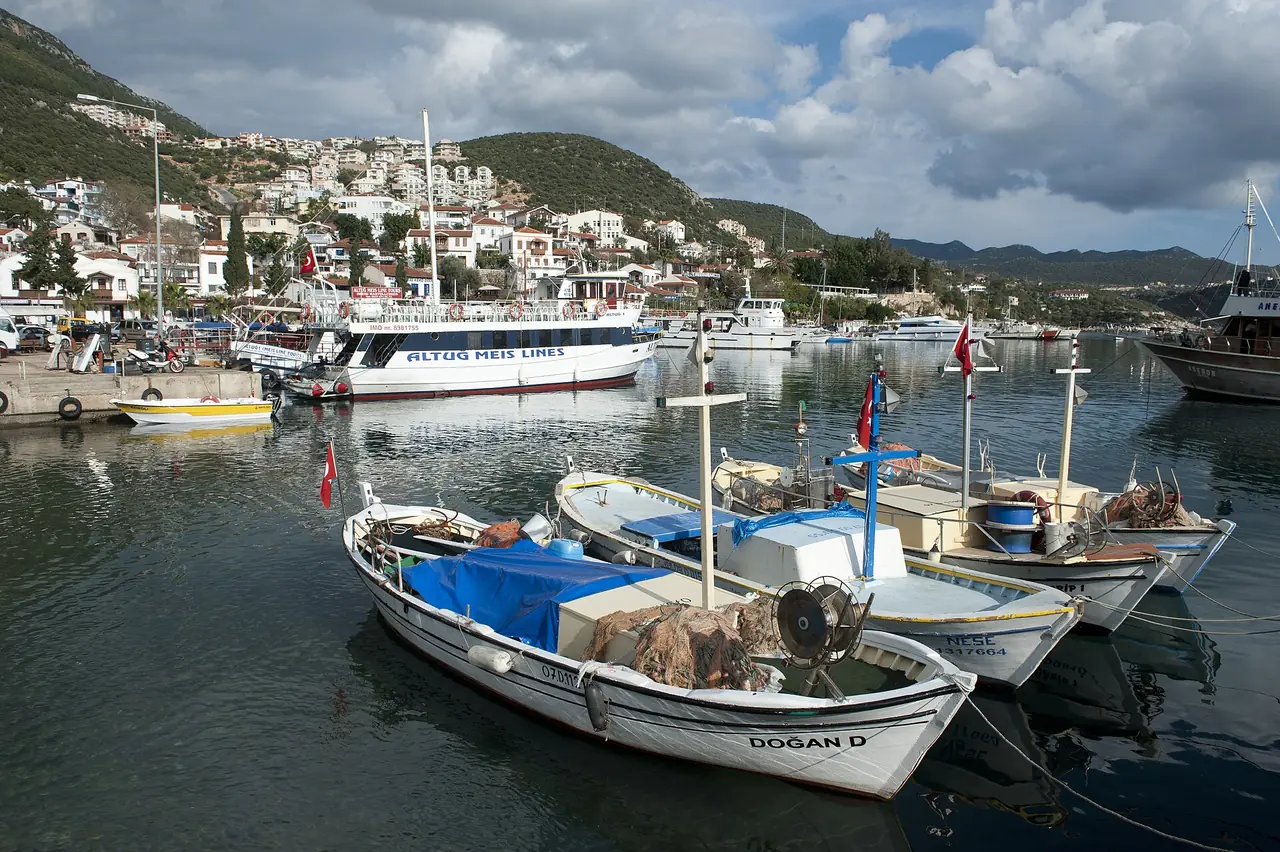
Diving in Kaş is the reason many people find this small Lycian town at all. The sea is clear, the seabed is rocky, and the dive sites start a short boat ride from the harbour. There are wrecks too: an air force cargo plane, a tank and a copy of a Bronze Age ship. This guide covers the Kaş dive sites, the season, the protected areas where you may not dive, and the rules on who can take you down. We checked two ministries, the state weather service and Turkish regulations on 20 November 2026. We name no dive centres and quote no prices, because we could not verify either on an official page.
Diving in Kaş at a glance
- Dive sites: 28 in the Kaş–Kekova protected area, says the Ministry of Environment. Local counts run from about 30 to 50.
- Season: April to January, according to the same ministry.
- Sea temperature today: 22.4 °C at Kaş on 19 November 2026, from the state weather service (MGM).
- No-dive zones: the water between Kekova Island and Üçağız, the west coast of Gata Burnu and Bohça İskelesi bay.
- Who may dive: certified divers, under a 1990 regulation that also requires foreign divers to dive with a Turkish guide. Its depth limit for recreational dives is 30 m.
- Prices: no official tariff exists. Ask the dive centre.
Why Kaş is Türkiye's diving town
The Ministry of Culture and Tourism's Antalya directorate says diving in Kaş began in 1986. It ranks the town among the world's important dive centres, with the Red Sea as its rival. The directorate's Kaş page credits clean water, a rocky seabed and summer visibility of 40–50 m. It also says the dive clubs are based at the yacht harbour.
The water is protected. The Kaş–Kekova Special Environmental Protection Area was declared on 18 January 1990 and covers 257.83 km², according to the Ministry of Environment's leaflet. It records about 1,000 marine species, including 117 fish. Its threatened species include dusky and white groupers, the sandbar shark, the monk seal, and loggerhead and green turtles. Seagrass meadows shelter young groupers. Our sea turtle beaches guide has more.
The protected area's 2014–2017 marine management plan counted 20 dive clubs in Kaş, most of them members of KASAD, the Kaş Underwater Association. In 2020, Anadolu Agency (AA) reported 18 diving schools and about 100,000 visitors a year. Nearly every dive starts from a boat, because shore access is very limited.
Kaş dive sites
The ministry's leaflet counts 28 dive sites and names two as priorities: Beş Adalar (Five Islands) and Kanyon (the Canyon). It says the islets between Gata Burnu and the Greek island of Meis hold the most important sites. The management plan names Kovan Adası, Heybeliada and Besmi Adası as heavily dived.
Other counts are higher. In 2020, KASAD's president told the DHA news agency that Kaş had 50 sites, 38 of them active. AA said about 40 that year, and a June 2025 Hürriyet Daily News story said more than 30 lie close to town.
The 28 named routes
When the 2019 season opened, DHA printed a list of 28 designated routes around Kaş. Some names translate neatly:
- Kanyon (Canyon), Tünel (Tunnel), and Mağara 1 and Mağara 2 (Cave 1 and 2)
- Uçan Balık (Flying Fish) and Uçak Batığı (Plane Wreck)
- Mavi Batık (Blue Wreck) and Likya Batığı (Lycian Wreck)
- Anfora Vadisi Reef (Amphora Valley) and Kaplumbağa Noktası (Turtle Point)
- Fener Kulesi (Lighthouse) and Mendirek Önü (off the breakwater)
- Büyük Rif (Big Reef), Deve Hörgücü Rifi (Camel's Hump Reef) and Karides Mağarası (Shrimp Cave)
The rest are mostly islets, rocks and caves, such as Besmi Adası, Sarı Ada and the Uluburun rocks. Your dive centre will pick sites by weather, current and your level.
The wrecks
- The Dakota. AA reported in 2019 that a military Dakota lies at 20 m, within reach of one-star divers, and later called it a C-47 cargo plane given to the town by the Turkish Air Force. The C-47 is the military DC-3, so you will also see it sold as the DC-3. Setur Marinas' magazine places it near Limanağzı. DHA dated the sinking to 2009, but a June 2025 Hürriyet Daily News story said an air force cargo plane went down "last year". That may be a second plane; we could not confirm.
- The Italian warplane. AA says it was shot down in the Second World War while bombing a British base on Meis. DHA reports in 2019 and 2021 said the cause is unknown and the plane is intact apart from its engines. Setur's magazine places it at the Flying Fish reef at 55–71 m, far below the 30 m recreational limit.
- The tank. DHA reported in May 2017 that a 45-tonne, US-built 1960 tank (an M-48, says AA) was sunk at 5 m in Kaş harbour, to be moved to 20 m off Güvercin Adası. DHA's 2019 report put it there.
- Uluburun III. The directorate says boatbuilder Hayrullah Kes built a copy of the Bronze Age Uluburun ship. It was sunk at Hidayet Koyu on 29 October 2006. It settled at 18 m, then slid to 32 m when ropes broke in a strong current. That is deeper than the 30 m limit, so ask which part of the wreck you will see.
The real Uluburun ship
The original wreck was found off Uluburun in 1982 by Mehmet Çakır, a sponge diver from Bodrum. The directorate dates it to the 14th century BC and puts the stern at 44 m and the bow at 52 m. Its finds have been shown at the Bodrum Underwater Archaeology Museum since 1999. You dive the copy, not the original.
The directorate calls Uluburun the oldest known shipwreck in the world. In October 2026, Culture and Tourism Minister Mehmet Nuri Ersoy announced excavations of a wreck near Kekova Island with amphorae 4,400–4,700 years old, NTV reported. So that claim may not hold for long.
Sea caves
The directorate lists the sea caves of Kekova Island, Aşırlı Island and Güvercin İni, and the Blue Cave (Mavi Mağara), 19 km from Kaş. Some can be swum, it says, but cave dives need technical equipment and an expert.
Kaş diving season and sea temperature
The Ministry of Environment and the management plan both give a season from April to January. Local accounts differ. KASAD's president told DHA in 2020 that divers work about six months a year. AA wrote in 2019 that diving is possible almost all year.
The directorate's average sea temperatures for Kaş name no source or period, so treat them as a guide:
| Month | Sea °C | Month | Sea °C |
|---|---|---|---|
| January | 17.3 | July | 25.9 |
| February | 16.7 | August | 27.9 |
| March | 16.8 | September | 26.5 |
| April | 17.5 | October | 24.3 |
| May | 19.6 | November | 21.6 |
| June | 22.9 | December | 19.0 |
For a live reading, the state weather service's sea temperature page on e-Devlet lists two Kaş stations. On 19 November 2026 at 06:00, Kaş read 22.4 °C and the Bayındır breakwater light 22.6 °C. Our winter swimming guide compares the rest of the coast.
Outside summer, ask before you travel which centres are still running trips, and what wetsuit they provide.
Kekova no-dive zones and protected sites
The ministry's leaflet bans diving on the west coast of Gata Burnu and in Bohça İskelesi bay, because of archaeological remains. The management plan adds the stretch between Kekova Island and Üçağız, an archaeological site it calls Ölüdeniz (not the lagoon near Fethiye). The directorate says the area was put under protection and diving at the sunken city is banned.
A Ministry of Culture and Tourism regulation of 20 March 2020 provides for opening chosen dive areas on protected underwater heritage sites. In November 2020, DHA reported that scientists had picked three points at Kekova, while Demre's mayor hoped they would open by summer 2021. We found no official notice that any has opened, so treat Kekova as closed to divers. You can still see the ruins from above on a Kekova boat trip, with a stop at Simena Castle in Kaleköy.
Two more rules apply everywhere:
- Take nothing. The 1990 diving regulation bans lifting cultural or natural objects from the seabed, even to hand them to a museum. Report what you find. Our Antalya shopping guide explains why antiquities can't leave Türkiye.
- Respect closed areas. The same regulation allows only scientific diving in military zones and protected underwater heritage areas.
Scuba diving in Kaş: the rules
For divers
The Türk Karasularında Sportif Amaçlarla Yapılacak Aletli Dalışlara İlişkin Yönetmelik covers recreational scuba diving in Turkish waters. It was published on 3 March 1990, and the WIPO Lex legal database lists no amendments. The 2011 tourism-sport regulation still refers to it. Its main points:
- Divers need a dive card from the Turkish federation or an internationally recognised certificate.
- Foreign divers must dive with a Turkish guide diver, so plan to dive with a local centre, not on your own.
- The depth limit is 30 m, or 42 m in training. Decompression dives are not allowed.
- Fishing for commercial purposes on a dive is banned.
For dive centres
The Ministry of Culture and Tourism's 2011 Turizm Amaçlı Sportif Faaliyet Yönetmeliği covers underwater sports for tourism. We read it in a copy published by TÜRSAB. In summary:
- A business diving at sea needs a marine tourism vessel operator certificate from the governorate, valid for up to one calendar year.
- Staff need a licence from the relevant sports federation for that activity.
- Operators must insure staff and guests against accidents and liability, and carry first-aid kit.
- Dive sites with marked coordinates, such as artificial reefs and sunken vessels, are set by a sports tourism board. For sea activities, it includes the harbour master and the coast guard.
How to check a dive centre
The Turkish Underwater Sports Federation's e-Devlet page lists a search for authorised dive centres and instructors, and a certificate check. We could not open the search, so we can't say whether it needs a Turkish e-Devlet login.
Before you book, ask:
- Does the centre hold the governorate's certificate for diving?
- Is your guide or instructor licensed?
- Is insurance for guests included?
- How deep will each dive go, and is any site in a no-dive zone?
- What does the price cover: boat, equipment, guide, lunch?
Planning your dive trip
Kaş is a long drive from Antalya: see our airport transfer guide and our Antalya to Kaş guide. The management plan says dive boats go out twice a day in season, so stay a few nights. Browse Kaş hotels such as Casa Bi on the peninsula or the Hideaway Hotel near the ancient theatre. For dinner, try Etna Fish House or Naturel.
Ask your instructor how long to wait between your last dive and your flight home. Non-divers in your group can take a boat to Kekova or spend a day at Kaputaş Beach. Our Kaş destination page has more.
FAQ
Can you dive in Kaş without a certificate?
The 1990 regulation requires a federation card or an international certificate for recreational divers, with separate rules for training dives. Hürriyet Daily News reported in 2025 that about 70% of divers visiting Kaş were certified. Ask a licensed centre about a course or a first supervised dive.
When is the Kaş diving season?
April to January, according to the Ministry of Environment. KASAD's president described about six working months a year, so check with a dive centre before a winter trip.
Can you dive at the Kekova sunken city?
No. Diving between Kekova Island and Üçağız is banned, and no official notice says the three proposed dive points have opened. See the ruins from a boat instead.
How deep is the plane wreck in Kaş?
AA put the Dakota at 20 m in 2019, within reach of one-star divers. The Italian warplane lies at 55–71 m according to Setur Marinas' magazine, beyond recreational limits.